AI-based Data Extraction and Data Detection
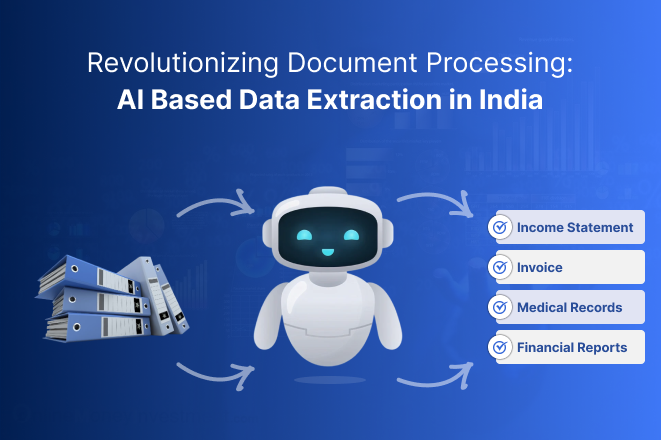
Revolutionizing Document Processing: AI Based Data Extraction in India
In today’s fast-paced digital world, every organisation creates and handles many documents, including invoices, contracts, medical records, and financial reports.
Productivity and compliance rely on processing them quickly and efficiently. Traditional document processing methods take a lot of time and are prone to errors. They also need a lot of manual work, which is not effective.
AI tools for detecting and extracting data from documents are building a system. This system will automate document control. This will ensure accuracy and speed up the workflow.
AI uses machine learning (ML), Optical Character Recognition (OCR), and Natural Language Processing (NLP) to read and understand documents. This technology can classify and extract information from documents in any format and structure.
This blog will cover the basic ideas of AI document scanning. The discussion will focus on document detection and data extraction. We will explore how these technologies are changing many industries.
How AI-Powered Document Detection Works
AI based document extraction employs advanced algorithms, machine learning models, and computer vision techniques to identify and process documents promptly and accurately. The whole process implies certain key stages:
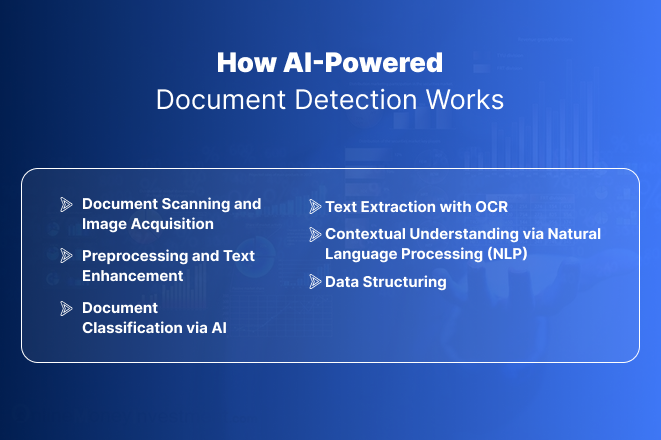
1. Document Scanning and Image Acquisition
The main job of using AI for document detection is to scan documents. This includes both physical and digital documents. You can create images using high-definition cameras, mobile devices, and scanners. You can also use cloud-based document capture services.
The AI document scanner improves image quality. It corrects distortions and ensures clarity for accurate data extraction from documents.
2. Preprocessing and Text Enhancement
We will prepare the scanned document to make it readable and correct. Then, AI can extract useful data from it. The following are important in this regard:
Noise Reduction: Avoiding background distortions, smudges, and unwanted marks.
Binarisation: The document is turned black-and-white for better contrast with text.
Deskewing: To align tilted and rotated documents.
Edge Detection: To find document boundaries and accentuate them for better precision.
3. Document Classification via AI
After the team pre-processes the documents, AI algorithms classify them by type, structure, and content. Machine learning models can recognise different document types. These include invoices, legal agreements, resumes, and bank statements. By accurate classifications, businesses can improve their workflows and automate their processing according to certain predetermined rules.
4. Text Extraction with OCR
OCR is the basic, fundamental method in AI document detection. It converts printed, handwritten, or scanned text into machine-readable data. Researchers now use modern deep-learning techniques with OCR technology. This helps improve accuracy for handwriting, different fonts, and multilingual documents.
5. Contextual Understanding via Natural Language Processing (NLP)
AI document processing not only extracts text but also uses NLP. This helps understand the context and meaning of the extracted text.
NLP algorithms look at the sentence structure. They find key phrases and extract important data like names, dates, and money values. This is particularly useful in the case of the automation of compliance checks and contract evaluation.
6. Data Structuring
After extracting the important data, AI will organise it into formats like JSON, XML, or spreadsheets. This makes it ready for business tools such as ERP systems, CRM platforms, or cloud storage. Data processing will happen automatically. This will help different organisations make decisions based on the data.
Key Benefits of AI Document Extraction and Detection
Every industry can learn to extract multiple benefits from AI-powered identification and data extraction from documents.
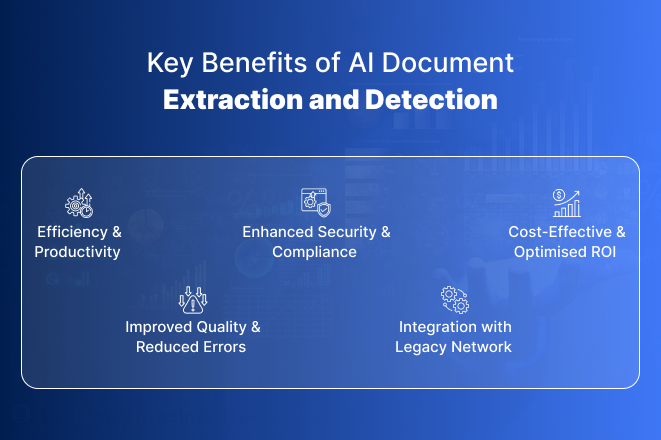
Efficiency and Productivity
Automating document processes frees human labour from the demands of data entry. AI can process thousands of documents in minutes. All this cumulates into saving on operational costs and the richness of the turnaround time.
Improved Quality and Reduced Errors
AI extraction has a much lower error rate than manual data entry. This is because fatigue and loss of attention do not affect it. Machine learning models continuously improve on accuracy, making the process dependably produce high-quality data output.
Enhanced Security and Compliance
Many industries, such as finance, healthcare, and legal services, require strict compliance with determining and regulatory compliance. AI document detection helps in the extraction, classification, and securing of sensitive data, hence preventing compliance risks.
Integration with Legacy Network
AI-driven document-processing technologies can work in real-time. This helps improve communication in enterprise software like SAP, Salesforce, and Microsoft Dynamics across business operations.
Cost-Effective and Optimised ROI
Automation handles repetitive tasks. This helps the business save on labour costs and allows more time for important activities. Returns come fast through AI applications as document extraction delivers efficiencies and accuracies.
Uses of AI Document Detection among Different Industries
AI document detection and extraction transform the industry by automating business processes and internal management decision-making.
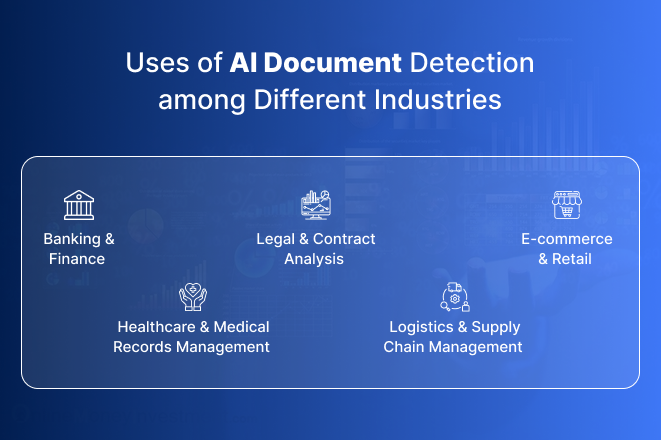
Banking and Finance
Banks and financial institutions process an enormous volume of paper, be it loan applications, invoices, or compliance documents. An AI-powered document detection system can improve KYC, fraud detection, and statement analysis. It also helps ensure that documents meet the standards set by authorities.
Healthcare and Medical Records Management
AI document processing helps find patient records, prescriptions, and claim forms. This technology is useful in hospitals, clinics, and insurance companies. Patient care has improved by reducing paperwork time. This also ensures quick access to accurate medical data.
Legal and Contract Analysis
Law firms or corporate legal departments will, day in, day out, swim in a sea of contracts, agreements, and case files. With AI-based document extraction, companies can quickly analyse contracts. They can identify clauses, understand their context, and find related risks. This process saves them from spending many hours reviewing documents by hand.
Logistics and Supply Chain Management
A strong supply chain business relies on precise documentation for inventory management, shipment labels, and invoices. AI automates document handling in the warehouse. This allows for real-time tracking and shorter processing times.
E-commerce and Retail
Retailers deploy AI document scanning to extract product data, analyse customer invoices, and facilitate returns. AI-powered document detection enables services to enhance customer experience by ensuring quick and accurate order fulfilment.
Challenges in AI Document Detection & Extraction
Despite its advantages, AI-powered document processing faces several challenges that organisations must address:
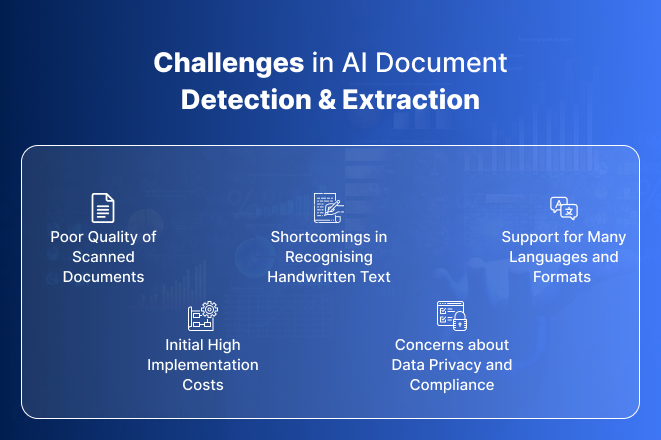
Poor Quality of Scanned Documents
OCR accuracy is affected by low-resolution images, faded texts, and background noise. The AI models should forever continue enhancing pre-processing techniques for increasing readability.
Shortcomings in Recognising Handwritten Text
Today’s OCR is exceptionally good at recognising printed text. However, it still struggles with handwritten documents. Handwriting styles are remarkably different. Machine learning models are getting better, but they still struggle with complex cursive and fancy writing.
Support for Many Languages and Formats
Different documents are produced in various languages and formats, also with different layouts. For example, researchers train models on an exceptionally diverse dataset. This helps extract information from multilingual documents. They can process both structured and unstructured formats.
Initial High Implementation Costs
These include the actual expense of deploying AI extraction solutions, infrastructure, model training, and integration with existing systems. As a result, adoption by small businesses becomes a challenge because of the cost.
Concerns about Data Privacy and Compliance
AI uses sensitive processing with sensitive data and thus raises alarm bells about privacy and compliance issues. Also, organisations must fortify their security infrastructure and even train each AI model on globally relevant data protection regulations compliance.
Future Trends in AI-Powered Document Processing
The future of AI based document extraction goes beyond text-based documents. AI models will pull data from audio files, videos, and graphic reports. This makes document processing more flexible and inclusive.
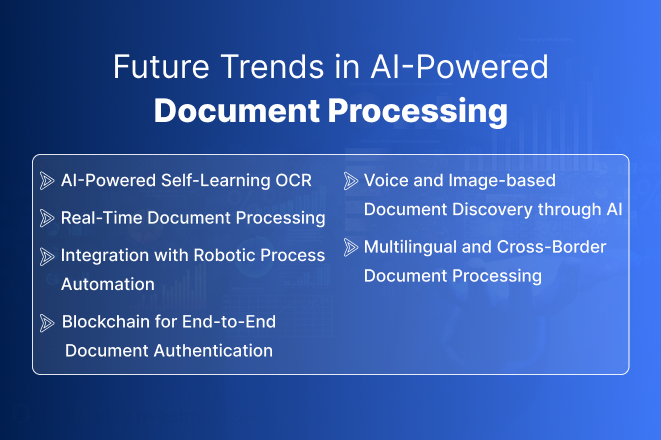
AI-Powered Self-Learning OCR
Standardised adjustment methods are used in conventional OCR systems to improve the accuracy of their interpretations. Next-generation AI-powered OCR models change old methods. They use deep learning and reinforcement learning to improve accuracy. This is true even for handwritten, noisy, or distorted documents.
Real-Time Document Processing
The document extraction is changing from batch processing to real-time automation. This allows companies to process information immediately. They can make faster decisions and respond more quickly.
Integration with Robotic Process Automation
Integrating AI with RPA adds value to the automation in work processes. For example, if AI uses data from a document through RPA applications in business, it can take action. This reduces the need for intervention in repetitive tasks like invoice processing and contract document approval.
Blockchain for End-to-End Document Authentication
Blockchain technology is getting a lot of attention lately. It helps secure the authentication of documents. This is important as digital fraud in documents is rising.
Voice and Image-based Document Discovery through AI
This AI document-built detection system will make one envious of looking ahead at how it could evolve. AI models will not just work with text documents.
They will also convert data from audio files. They can take information from videos and provide images from graphs. This makes document processing more flexible and inclusive.
Multilingual and Cross-Border Document Processing
Businesses that hire international employees or operate on a global basis require document filing in multiple languages. AI can handle all these tasks. New improvements in translation and context processing will help handle multilingual documents. This will make it easier to access and follow the rules.
Conclusion
AI-based document extraction and data detection have transformed document management. This change comes from automation, which improves accuracy and efficiency in data processing. Businesses that use AI for document scanning and extraction reduce manual work. They also save money and gain insights from unstructured data.
AI still faces challenges in preparing printed documents, processing multiple languages, and understanding handwritten texts. We must resolve these issues before we can say AI has fully matured. The future of AI document extraction looks bright. We see progress in real-time AI processing, blockchain security, and deep learning OCR.
A company can gain a competitive edge in the future if it adopts AI document detection early. The company will be way ahead in making their activities streamlined regarding processes, compliance, and ultimately making better decisions.