Digitise, index, and secure patient records with AI‑powered OCR solutions
Streamline Medical Records with OCR for Healthcare in India
Transform the way the hospital deals with patient information with cutting-edge OCR in healthcare technology. Invoice Extraction provides the best solution for Indian health institutions: AI software for automatically extracting and organising data from prescriptions, lab reports, admission forms, etc. EMR integration boosts speed and reliability, healthcare records OCR eliminates boring manual entry to business efficiency. Come into the brighter tomorrow of OCR medical records and give a new meaning to productivity and compliance.
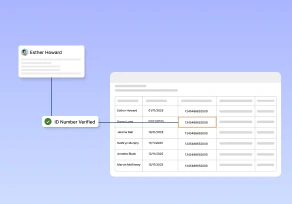
Why OCR in Healthcare in India?
OCR means Optical Character Recognition; it can convert printed forms so that they may be recognised, altered, and searched by machines. In healthcare, this conversion, known as OCR, is done for the digitisation of patient charts, prescriptions, lab tests, insurance claims, and even discharge summaries that clinical and administrative procedures are smooth and there is rapid, accurate access to key information.
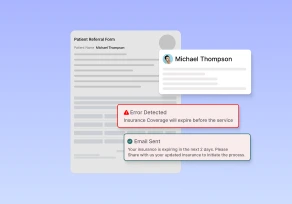
India’s healthcare infrastructure remains largely dependent on paper-based medical records, particularly in small clinics, rural hospitals, and diagnostic centres. Right from scribbled prescriptions to physical test reports, huge amounts of unstructured data pose challenges in the storage, retrieval, and exchange of patient information in an error-prone manner.
- Eliminate manual entry backlogs
- Ensure better compliance with regulatory and privacy issues such as HIPAA, DISHA, and ABDM guidelines
- Enhance accuracy in patient documentation
- Decrease inefficiencies in operations
- Speed up patient history access to enable better clinical decision-making
Key Advantages of OCR
within the Healthcare Environment
Using OCR for medical records opens up a wealth of real-world advantages for clinics, hospitals, and diagnostics laboratories, particularly in India’s fast-digitising healthcare industry.
Accessibility & Efficiency
With OCR in healthcare delivered through AI, patient reports can be accessed at lightning speed—no more rummaging through thick paper files. Consultations and clinical decisions are expedited while better informed because physicians, nurses, and the administrative staff can instantly call up digital prescriptions,
Improved Quality of Care
Electronic records enable rapid retrieval of vitals, diagnosis, and treatment history by doctors in both real and paper prescriptions, triaging more quickly, having fewer diagnostic errors, and better clinical outcomes.
Data Discoverability & Analytics
After patient data is digitised and formatted, hospitals are able to query across cohorts, identify trends in vitals or medication, and execute predictive models. This enables research, early diagnosis, and improved public health planning.
Cost Reduction & Space Saving
OCR reduces physical storage requirements to a minimum, offloading precious space in overstuffed urban clinics and tier-2 hospitals. OCR also minimises reliance on manual data-entry personnel, thereby lowering operational expenditure.
Security & Compliance
Today’s OCR solutions have bank-grade encryption, access controls, and audit trails built in, allowing providers to comply with local and global data protection regulations, much like HIPAA, DISHA, and ABDM in India.
OCR in Action: Typical Workflow
Scanning Software
Curious about how medical records OCR in healthcare environments happens? Here’s a step-by-step simplified workflow that demonstrates how clinics, hospitals, and laboratories in India are digitising their records with OCR:

Document Collection
Patient registration forms, handwriting on prescriptions, lab tests, admission reports, and old paper files are collected from departments.

Secure Digital Archiving
File archival is carried out in encrypted cloud or on-premises repositories with access control, audit log, backup, and compliance support.

High-Resolution Scanning
Documents are scanned using medical-grade or standard high-res scanners. Mobile capture can be applied to smaller clinics and also for field trips.

OCR Processing
Artificial intelligence-based OCR engines scan and extract data from images, even handwriting smudges or multi-language documents. Clinical accuracy is verified by manual checks.

Indexing & Tagging
The data is automatically indexed by patient name, record type, date, department, etc., and this does not require any effort for searching or retrieval.
Integration with EMR Systems
Structured data is poured into the already existing Electronic Medical Records (EMR) or Hospital Information Systems (HIS) for use by physicians and staff.
How OCR for Medical Records Works?
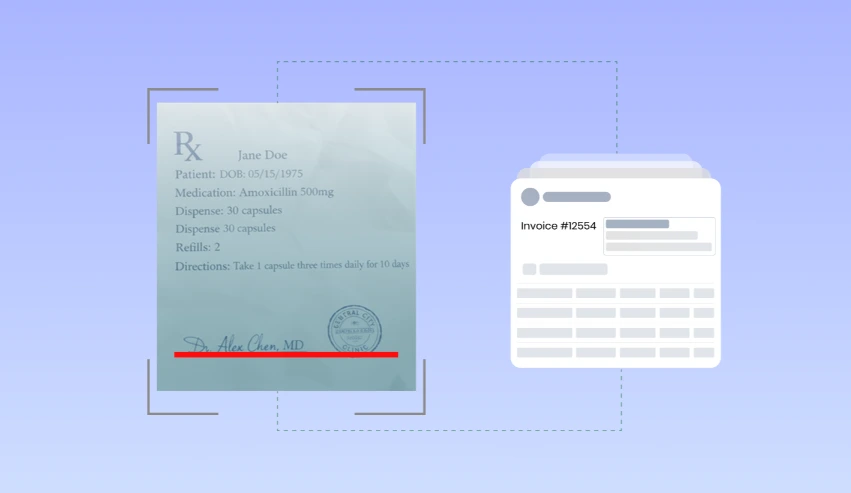
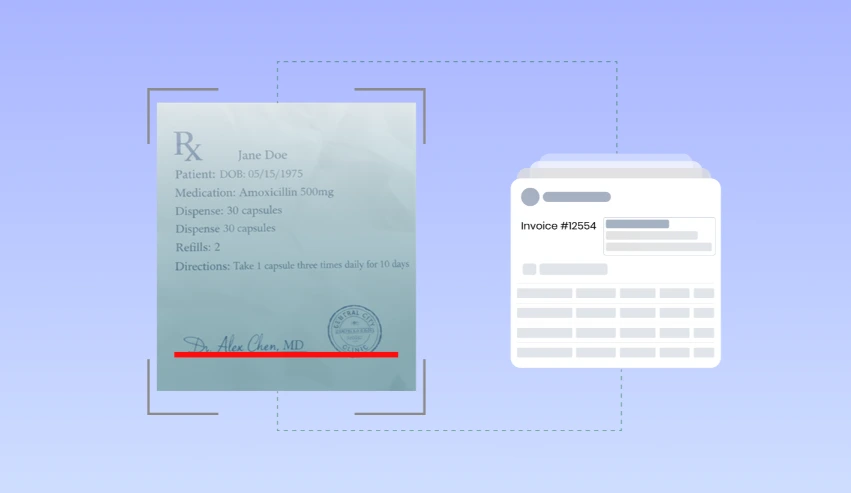
Image Acquisition
Medical records may be scanned or photographed by a camera or by using a smartphone. The images could consist of prescriptions, test reports, and discharge summaries.
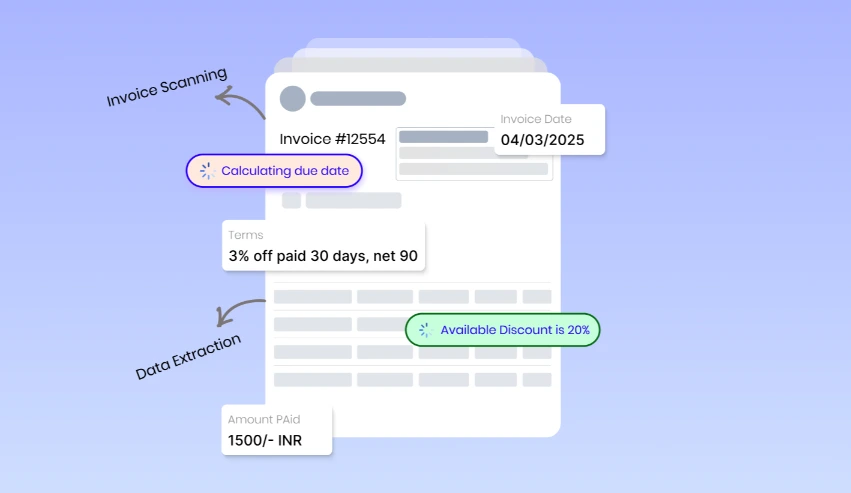
Preprocessing and Enhancement
Image quality is enhanced by the removal of noise from the image, changing the contrast, or straightening up the content so that it may be recognised accurately.
Character Recognition
With machine learning and AI-based models, the OCR engine recognises characters (letters, digits, symbols) in the image, even if handwritten.
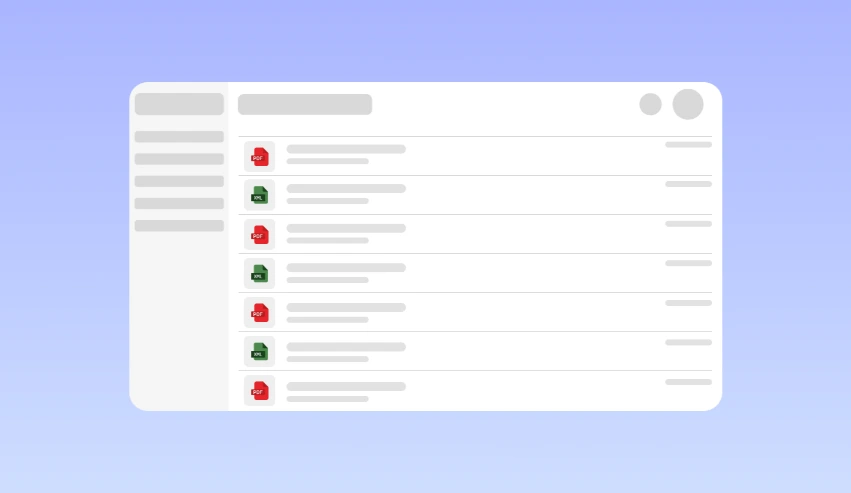
Parsing & Structuring
The data is extracted and parsed into structured formats like tables, EHR-compatible XML, or searchable PDF, ready to be incorporated into hospital systems.
Case Study

Case Study 1
Faster Insurance Processing in a Tier-2 City Hospital
Problem:
An NABH-accredited private hospital located in a tier-2 city was experiencing delays in the submission of insurance claims as it was being processed with manual sorting and scanning of documents.
OCR Solution:
OCR integration was introduced so that the billing and discharge system could read numbers automatically from lab reports, invoices, and treatment summaries.
Effect of OCR at Private Hospital:
Time to file claims had been reduced from 3 days to just one
Reduced rejection rates due to increased documentation
Insurers were happy about the faster turnaround for pre-approvals
Case Study 2
Automating Prescription Processing in a Private Clinic Problem
Problem:
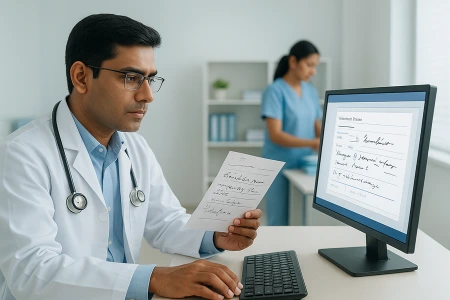
An operational multispecialty clinic in the south of India had inconsistencies and delays in hand-written prescription transcription, especially in local scripts.
OCR Solution
:
They implemented an AI-driven OCR solution for medical records, with the goal of extracting drugs, dosages, and instructions from English and Tamil prescriptions.
Impact of OCR in Healthcare :
pact of OCR in Healthcare
Reduced manual data entry time by over 60%
Enabled seamless handover to an e-prescribing system
Improved patient safety and billing accuracy
Fast OCR for Medical Records | Accurate Data Capture | Easy EHR Integration
Quickly Turn Medical Records into Digital Files
Say goodbye to manual entry for hours! Our state-of-the-art OCR for medical records will allow you to extract patient information from physical documents for you quickly, accurately, and securely. From intake forms, to prescriptions, to clinical notes, OCR in healthcare will modernize your approach to processing patient documents, enabling providers to focus on what's important: providing quality patient care!
Frequently Asked Questions About
OCR for Receipt Scanning Software
In medicine, 'OCR' is shorthand for Optical Character Recognition. It is the process of converting printed physical records like prescriptions, lab results and medical record pages into digitally-readable text. It provides quicker retrieval of data, better data organisation in hospital IT systems such as EMR or HIS.
Optical Character Recognition (OCR) is the process of taking a scanned document and converting it into digital, editable text, which is immediately readable and searchable. In the field of healthcare, the OCR helps to digitally convert and systematise vast quantities of medical records, making them substantially more efficient, accessible, and compliant.
Yes. With AI models trained on medical handwriting, Indian handwritten script OCR in healthcare can reach up to ~70–80%. Precision is enhanced by iterative use and human verification layers.
Absolutely. Contemporary OCR engines for Indic scripts, such as e-Aksharayan, support regional languages, such as Hindi, Tamil, Telugu, Kannada, Gujarati, etc., and thus it is also applicable for India’s multilingual healthcare domain.
Yes. Some of the leading OCR in healthcare providers provide end-to-end encryption, role-based access controls, and also secure APIs. Tens of thousands abide by international best practices for HIPAA-like compliance, and India’s ABDM and DISHA frameworks.
It varies by the number and type of documents. Small clinics can digitise in 2–4 weeks, whereas large hospitals will need staged rollouts. Bulk digitisation services are also offered for faster processing.